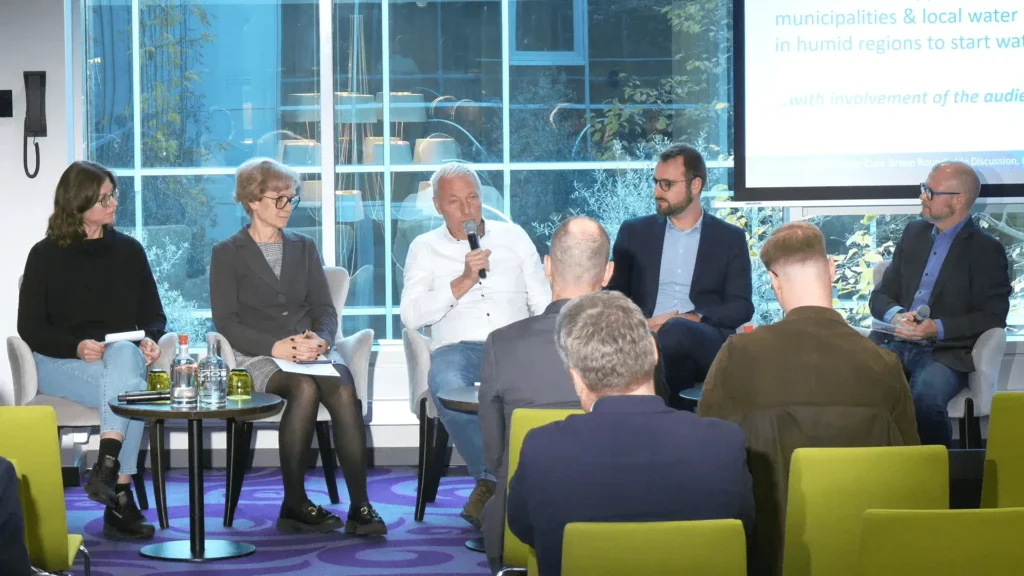
In early November 2025, WaterMan’s second EU roundtable was scheduled, with a clear agenda in place. But events took a somewhat different turn – opening up unexpected new opportunities to promote water recycling in the Baltic Sea region.
Already in January 2025, a first roundtable had been held to discuss the concerns and priorities of the WaterMan project with representatives of the EU administration. At that time, the debate focused on the opportunities that the planned revision of the Water Reuse Regulation (2020/741) might open up. The aim was to ensure that, in addition to its existing focus on Southern Europe and the agricultural use of recycled wastewater, the specific perspective of the Baltic Sea Region would be better reflected in future. Due to climate change, the humid north is also experiencing more frequent regional heatwaves with temporary water shortages, alternating with increasingly extreme rainfall events.
Rainwater recycling is a key aspect here. In the Baltic Sea Region, this means both tapping additional sources and opening up further uses for recycled water, including the irrigation of urban green spaces, process water in industry, and cleaning of sewer networks. Wherever drinking water quality is not required, different levels of fit-for-purpose water should be used for different applications in future, in order to stabilise local supply. The seven pilots and two feasibility studies carried out by WaterMan have shown how much of this can already be achieved with existing technologies today. What is still missing, however, are legally robust definitions of these different quality levels – ideally as part of a revised Water Reuse Regulation.
Politics in motion – making use of opportunities
With this, the agenda seemed clear when a smaller group of WaterMan partners once again travelled to Brussels in early November 2025 for a concluding roundtable. The aim was to build on the momentum created earlier in the year. But politics is often what happens while you are still making other plans. In such moments, the challenge is to turn changing constellations into something productive.
Loïc Charpentier, Head of Advocacy at the platform Water Europe, used his keynote to point to very recent political developments – and to the new opportunities that come with them. The expected recast of the Water Reuse Regulation will be delayed. Instead, the new EU Water Resilience Strategy is being pushed forward, and that may well mark the more significant turning point. For this strategy officially recognises that water scarcity increasingly affects humid regions as well, and it identifies water recycling as a central instrument for stabilising water supply in the future.
A legally binding water quality classification system would, of course, still be highly desirable for this purpose. For now, however, the key task is to seize the new opportunities at hand: The Water Resilience Strategy is linked to the EU’s seven-year financial framework, and substantial funding is being made available.
Turning the focus from Brussels to the Member States
In political and strategic terms, WaterMan therefore has to reorient itself: away from Brussels and towards the Member States that manage these funds. WaterMan Lead Partner Tobias Facchini from Region Kalmar County is optimistic: “Based on the pilots and feasibility studies we have developed, we will convince the national authorities of the potential of a Baltic Sea Region-specific approach to water recycling. It can make a decisive contribution to securing sufficient volumes and thus strengthening the EU’s water resilience.”
At EU level, WaterMan has pushed the issue as far as is realistically possible for now. From here, the political focus needs to shift to the national and regional level. The next step is to spread the word, engage the relevant decision-makers, and get things moving on the ground – hands-on and local. That has always been one of WaterMan’s great strengths anyway.
» Watch the Roundtable Discussion in full length

