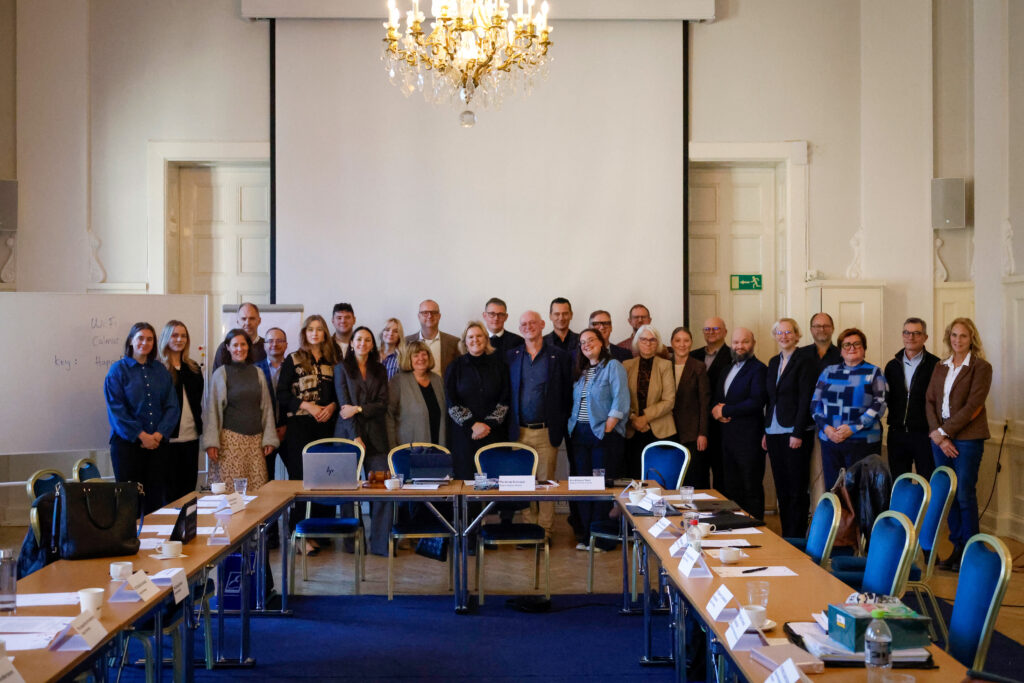
Euroregion Baltic’s General Assembly met in Kalmar to discuss future priorities, new opportunities for cross-border cooperation and the role of regions in shaping Europe’s future. The meeting also welcomed a new Director and unveiled the organisation’s new visual identity.
At the heart of Euroregion Baltic’s cooperation is a shared ambition: a healthier Baltic Sea, better opportunities to learn and work, and communities where people of all ages can build their future.
Since 1998, Euroregion Baltic has brought together local and regional authorities across the South Baltic to exchange experience, build partnerships and pursue common interests. Today, demographic change, environmental challenges, a shifting geopolitical landscape and evolving European priorities give this cooperation renewed relevance.
As a European Grouping of Territorial Cooperation (EGTC), Euroregion Baltic seeks to bring together its members’ knowledge and experience to develop joint initiatives that respond to regional needs while helping address challenges of wider European relevance.
Connecting regional priorities with Europe’s future
Euroregion Baltic’s current focus areas – water, skills and demography, and youth – provide a foundation for addressing shared challenges and identifying new opportunities for cooperation.
Water cooperation connects the health of the Baltic Sea with the wider challenges of sustainable water management, climate adaptation and environmental resilience. The European Water Resilience Strategy creates opportunities to bring regional experience and cooperation into a broader European framework.
Skills and demography are central to the future of communities across the South Baltic. Ageing populations, labour shortages and the need to attract and retain talent call for stronger cooperation between public authorities, education providers, businesses and civil society. The EU’s Union of Skills and the emerging European debate on the right to stay offer an important policy context, particularly for smaller towns, rural areas and island communities.
Youth participation is an integral part of Euroregion Baltic’s cooperation. Through its Youth Council, young people have a platform to contribute their perspectives, engage in cross-border dialogue and help shape initiatives affecting their future.
Looking ahead: A stronger platform for cooperation
The discussion in Kalmar took place at a time when the European Union prepares its next Multiannual Financial Framework and shapes Cohesion Policy beyond 2027.
Building on its established partnerships and understanding of regional needs, EGTC Euroregion Baltic aims to play an active role in shaping new opportunities for cross-border cooperation. The organisation stands ready to bring its members’ experience, knowledge and perspectives into European discussions, particularly on the future of Interreg South Baltic and the implementation of the EU Strategy for the Baltic Sea Region.
To support these ambitions, Euroregion Baltic is also strengthening its own capacity and visibility as an EGTC.
The General Assembly welcomed Iwona Kieda, who took office as Director on 1 October 2026. Her priorities include strengthening the organisation’s operational capacity, supporting cooperation among members, building new partnerships and connecting regional priorities with European opportunities.
New visual identity
The meeting also saw the unveiling of Euroregion Baltic’s new visual identity. Inspired by the geography of its member regions and the Baltic Sea that connects them, the new logo reflects the organisation’s shared identity and future ambitions, marking a new chapter in its development and outreach, across the Baltic Sea region and beyond. The logo was selected through a design competition organised in cooperation with the Academy of Fine Arts in Gdańsk. The winning design was created by Maria Dąbrowska.