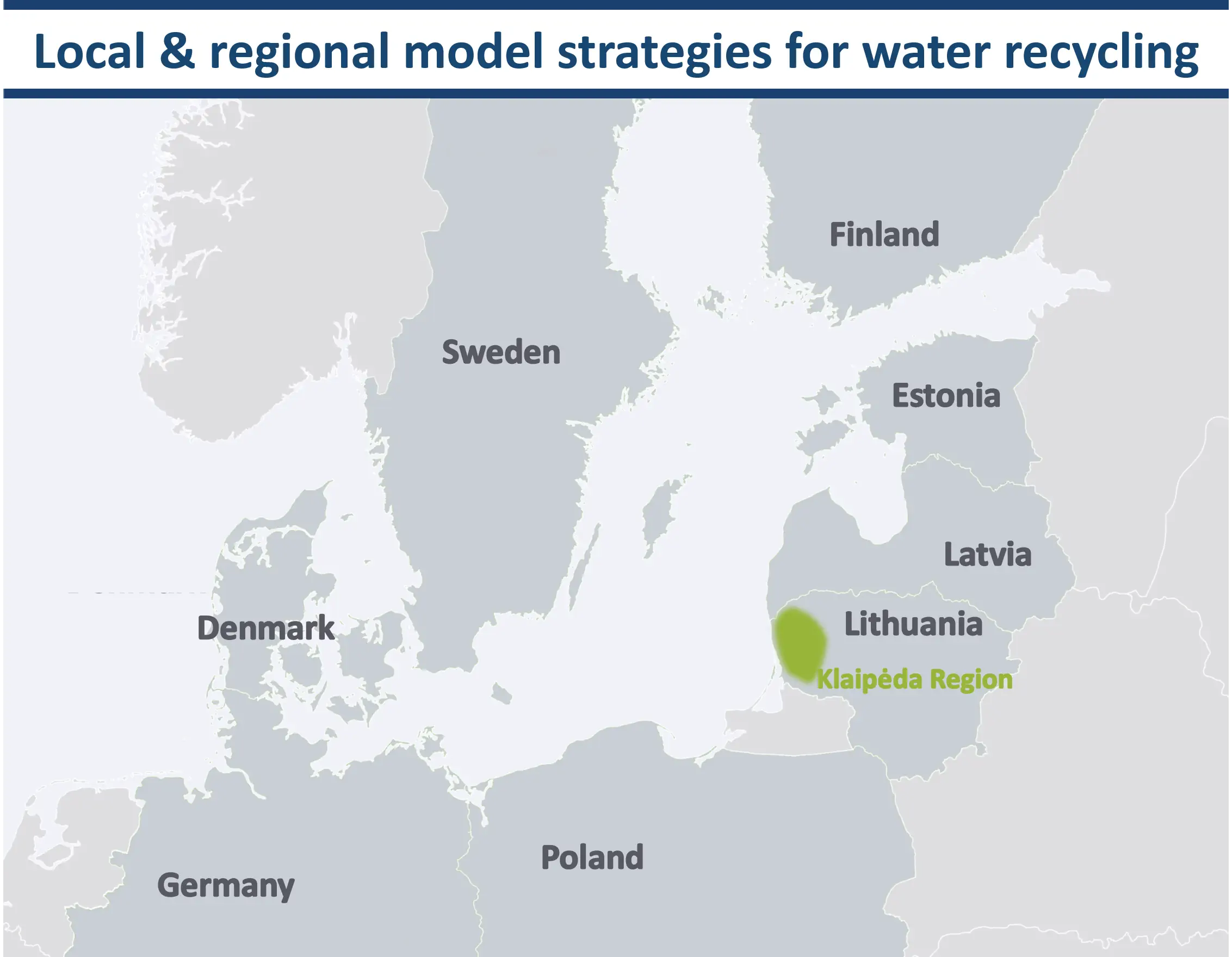
Looking at Lithuania’s national climate data, one might assume that droughts and water scarcity are issues for the distant future, not for the present – especially in such a humid country. Yet the Klaipėda region chose to think ahead and act early. In numerous stakeholder dialogues, it became clear that farmers in the local area had already experienced periods of shortage. That is how a pioneering project came about in Gargždai: Lithuania’s first retention pond with an extraction point – and the country’s first real step into water recycling.
There is a gap between national climate monitoring and the particular relationship farmers have with the weather. It is rarely their best friend, often a difficult partner, and sometimes their greatest enemy. While ministries and research institutions analyse tables and calculate projections, farmers are out in the fields every day, feeling the wind on their faces. Or rather: in recent summers, they have increasingly felt a noticeably hotter sun on their faces, the air standing still and water reserves gradually drying up. Even if nationwide climate data did not yet register a problem, water scarcity was already a reality at local level in the Klaipėda region on Lithuania’s southern coast – albeit within a limited area and for limited periods of time.
The fact that this issue received a certain degree of attention at higher levels at all, and that the affected farmers did not have to deal with it entirely on their own, is due to the commitment of the Association of Klaipėda Region Municipalities. In the truest sense of the phrase, it set out across the region, in cooperation with researchers from Klaipėda University, to explore local conditions in greater depth: carrying out more detailed climate and water analyses and, above all, engaging in a broad process of exchange and participation with local stakeholders. The aim was not only to consider the scientific evidence that feeds into tables and calculations in the form of averages, but also to take anecdotal evidence seriously in a systematic way: to listen to what farmers had experienced, to ask what local water utilities and municipal representatives had to say, and to bring them all together around one table for an open exchange.
Systematically capturing anecdotal climate data
The field research was led above all by Valdas Langas and Vytautas Bernadišius of Klaipėda University. The picture that emerged is, in fact, quite typical of the Baltic Sea Region: overall supply is not at risk on average over long periods of time. But viewed locally, both flooding and drought periods, as well as temporary bottlenecks, are already becoming more frequent. “The systematic capture of anecdotal data has enabled us to turn isolated observations into an overall assessment of the situation,” explains Langas. “On this basis, we can derive concrete priorities for the coming years.” And this includes not only further efforts in flood protection, but also initial pragmatic steps towards water recycling.
Pragmatic, in this context, means beginning with water recycling on a small scale and with simple, obvious measures that can be implemented easily. As a complement to existing supply, not as a substitute. Nor is the aim to achieve drinking water quality, but rather to provide fit-for-purpose water in different quality levels that can be used in agriculture or for municipal services such as street cleaning or the maintenance of green spaces, thereby relieving the drinking water supply of these uses. Instead of trying to tackle many conceivable solutions at once, the region is deliberately focusing on simple, robust measures that can have an effect without long lead times and that enable institutional learning curves. Retention ponds at critical points, the targeted use of rainwater and wastewater for purposes that do not require drinking water quality, and visible demonstrations form the starting point. In this way, a gradual ramp-up is taking shape that conserves resources, creates confidence in action, and brings the issue of water recycling into the public debate.
A great deal of awareness-raising and the courage to become the first municipality to build practical experience
That said, “easy to implement” is a relative term in a country where water recycling has so far not been a topic at all, and where the debate has focused primarily on flooding. In this respect, the first project now being driven forward by Valdas and his team was truly a pioneering effort in Lithuania’s national context. At the same time, the project turned a problem into an opportunity. For a carefully selected site in the municipality of Gargždai, a flood retention pond was planned that would also include an extraction point. Until now, retention facilities in Lithuania have been used primarily for flood protection and flood control. Gargždai was now to show how safety infrastructure could also become a supply solution – and at only marginal additional cost. “We did not just want to drain the water away; we wanted to see it as a resource – something valuable that could be reused,” explains Langas.
When it came to building the retention pond and implementing the technical solution for water recycling, the team was able to draw, among other things, on the example of WaterMan partners in Västervik, Sweden, who have been creating “Multi-dams” with water extraction points for years. Close professional exchange was also helpful with regard to monitoring strategies, testing parameters and operational issues. The real pioneering dimension of the retention pond in Gargždai, however, lay above all in the legal framework within Lithuania’s national context. “Water recycling is not yet anchored in Lithuanian legislation,” says Mindaugas Šatkus, who oversaw the practical implementation of the project for the municipality together with his colleague Feliksas Žemgulys. Before the first excavator could move in, the two of them first had to lay the legal groundwork. “There were fundamental questions that had to be clarified – legally, technically and organisationally.” EU Regulation 2020/741 does apply to Lithuania’s agriculture and municipal wastewater, but its application to rainwater and municipal uses has not yet been regulated. The whole issue of water recycling remains underdefined in Lithuania. For Gargždai, that meant many discussions, a great deal of awareness-raising, and the courage to become the first municipality to build practical experience.
Water recycling is no longer an abstract term, but a pond and a pump
Since early 2025, the new retention pond has been in place: more than 7,000 square metres in size. It was created in a popular area near a football pitch and cemetery, right in the middle of a well-used local recreation zone. This particular location is no more a coincidence than the fact that the site has not been fenced off. “We did not want to create an enclosed technical site, but to apply the other principles of our model strategy at the same time,” explains Mindaugas Šatkus, who managed the project for the municipality. For him, the project is also about visibility, transparency, information and public outreach. The retention and recycling pond has therefore been deliberately designed as a demonstration site. With the help of information boards and through on-site visits and training formats, the growing problem of water scarcity and the possibilities of water recycling as a response can be explored here in a particularly tangible way. Wherever water recycling is new – and that is almost everywhere in the Baltic Sea Region – the first task is to reduce psychological barriers and build trust. Outside agriculture, many people are not even aware that, below drinking water quality, there are further EU-defined quality classes for fit-for-purpose water that are entirely safe for many uses, even where people come into direct contact with it. That is why this site is also meant to show how quality is safeguarded through sampling plans, including for E. coli, turbidity and conductivity. A place of learning has been created around the retention pond, one in which knowledge will be able to flow in future – about hydrology, ecology and climate adaptation. The municipality is also active on social media.
“Since we have been able to show people what water recycling looks like in Gargždai, it is no longer an abstract term for many of them, but a pond, a pump and a hose – something they can understand and touch.”
The thorough preliminary work carried out through the stakeholder dialogues also provides a sound basis for deciding where action could and should come next. Districts such as Šilutė and Kretinga are under particular pressure, with recurring agricultural distress and high irrigation demand during drought periods. At the same time, most municipalities in the region – with the exception of the city of Klaipėda – still lack concrete plans for water recycling. If retention ponds with extraction points were available there too, as they now are in Gargždai, farmers could draw on these sources during dry periods without placing additional pressure on public networks at times of peak demand.
Standardise, scale up, and refine the rules
In future, such ponds are to be created deliberately as buffers for water supply at suitable sites, for example near public facilities such as schools, sports grounds or municipal depots. The strategy envisages developing usage concepts for them that take account of potential off-takers, legal requirements, and key technical and logistical parameters. It also calls for standardised extraction solutions, clear rules on quality and liability, and exchange with national authorities and partner regions – so that the first experiences with water recycling can lead to a more consistent practice across Lithuania as a whole. Economically, recycled water can be cheaper than drinking water, provided the legal framework allows for it. Valdas Langas’s model strategy therefore argues for clear legal rules beyond agriculture as well, for example for municipal services and industry. A legal framework defining standards for quality, liability and responsibilities would also be helpful, whether it is established at European or national level.
Politics moves slowly; the weather is changing faster in some places
The wheels of politics turn slowly, while weather patterns in parts of the country are changing much faster. That is why the Klaipėda region is, for the time being, taking matters into its own hands – actively encouraging the construction of more water recycling measures, continuing to involve municipalities, and defining roles and responsibilities: technical departments prioritise sites, utilities operate the infrastructure, municipalities and the region communicate, and university partners support the evaluation.
Building on the involvement of all municipalities and utilities that has already taken place, the region is now putting in place a more binding form of coordination. Roles and responsibilities are clearly defined: municipalities and technical departments prioritise measures, utilities operate the infrastructure, and national authorities and specialist institutions provide data, regulation and technical guidance. On the basis of municipal surveys, documented drought events and available water statistics, needs, risks and potentials are regularly assessed and reflected on together with the actors involved. In addition to demonstration projects, the strategy foresees guidelines and rules, further scientific studies, and exchange with the Ministry of Environment and other national actors. In this way, experience gained from initial applications can feed into the further development of legislation and into an increasingly consistent water recycling practice.
Take local experience seriously – and get started
What has been developed in Lithuania, and is continuing to evolve there, is a model strategy in the best sense of the term. It can become a model for many regions around the Baltic Sea where water recycling has so far played no role: start with what is relatively easy to implement. Retention ponds for flood protection are an established concept across the Baltic Sea Region. In times of climate change, this region is defined precisely by the seasonal alternation between too much and too little water. By adding one small extra – extraction points – these urgently needed retention ponds become an effective buffer that can significantly relieve the drinking water system during periods of scarcity. Could wastewater recycling also become an option in Lithuania one day? That is certainly possible. For now, however, the analysis by Valdas Langas, Mindaugas Šatkus and Feliksas Žemgulys suggests that rainwater recycling can already take this still very humid region a long way.
Taking local experience seriously – and getting started – is, in a sense, the strategic core message of the WaterMan project. In the Klaipėda region, that message has been understood and implemented in exemplary fashion. This pioneering effort has, for the first time, embedded water recycling systematically in the regional agenda and laid a solid foundation for further pragmatic steps.
In-depth information on the strategy
Strategy overview (final status)These slides present the final shape of the strategy, including its context, adoption, and key lessons learned.
Account of the elaboration processThese slides present the elaboration journey of the strategy step-by-step from first discussions to the adopted version.