- Home
- News
- Water Recycling Toolbox
- Use cases & technical-organisational solutions
- Stormwater recycling for fountain operation and greenery irrigation
- Diverse utilisation of stormwater with the aid of “multi-dams”
- Stormwater retention pond for water recycling in municipal services
- Rain garden for the greening of a public car park
- Recycling municipal wastewater for irrigating green spaces
- Recycling municipal wastewater for agricultural use
- Recycling municipal wastewater for commercial use
- Recycling treated wastewater for hydrogen production
- Recycling treated wastewater in public buildings
- Recycling public swimming pool water for canal flushing
- Regional pathways & action plans
- Practical guidelines and tools
- Best practices outside the Baltic Sea Region
- Policy Dialogue
- IN THE LOOP – our three-edition guide to get started with water recycling
- Water Recycling Helpdesk
- Use cases & technical-organisational solutions
Recycling municipal wastewater for commercial use
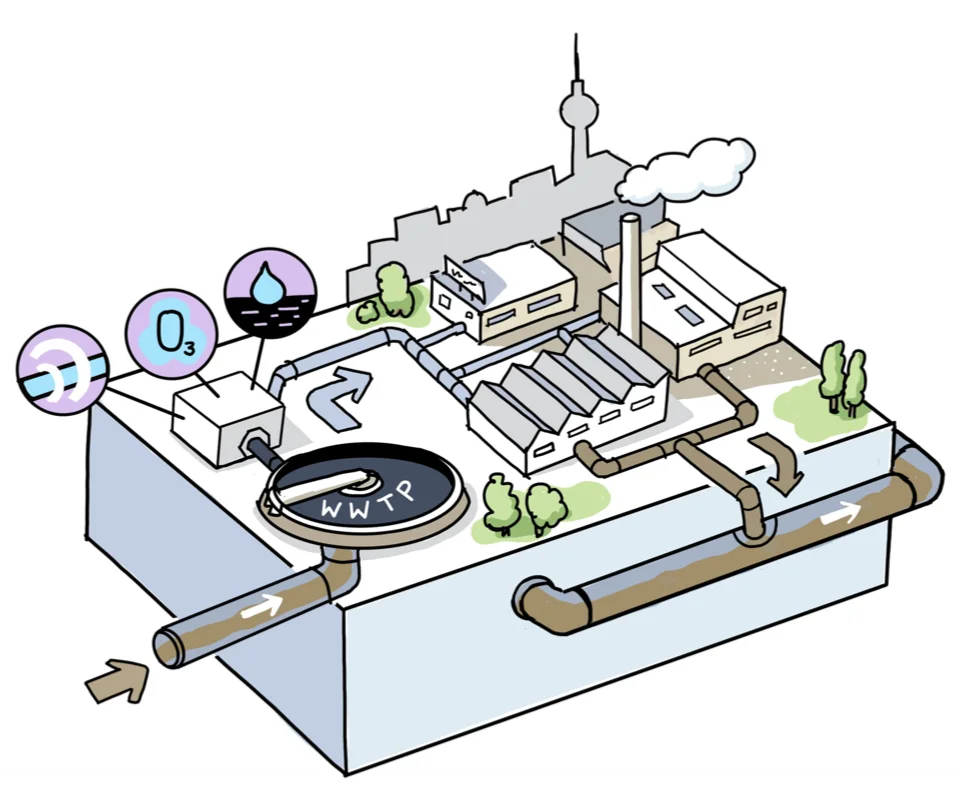
Brief intro to the WaterMan pilot measure
The feasibility study evaluates the potential for using recycled water in industrial applications close to the Berlin-Ruhleben wastewater treatment plant, one of the largest in Berlin. As part of this assessment, the study examines how the planned additional treatment processes improve the effluent quality, thereby reducing efforts to implement water reuse: coagulation and flocculation further reduce nutrient emissions, UV disinfection lowers the bacterial content, while ozone or activated carbon adsorption remove micropollutants. Additionally, the study identifies whether further treatment is necessary for specific reuse scenarios. Risk assessment and management aspects are also considered.
In order to maximise the sustainability of water recycling, the project is geared towards local utilisation. The wastewater treatment plant is located in an industrial area, and potential commercial customers have already been identified within a radius of just three kilometres – making short distribution routes feasible and supporting a circular use of water on site.
- Type of pilot measure: Feasibility study
- Location: Berlin (Germany), Ruhleben district
- Water source: Treated wastewater from urban wastewater treatment plant
- Type of treatment: coagulation, flocculation, UV disinfection, ozonation or adsorption onto activated carbon, other fit-for-purpose treatments
- Target water quality: Fit-for-purpose water of varying quality
- Utilisation: Process water, cleaning water and cooling water for industry and commerce, optional: urban irrigation
- Return to natural cycle: Discharge into sewage system, evaporation (in cooling towers)
- Responsible: KWB – Berlin Centre of Competence for Water gGmbh
- Completion of the study: Nov 2025
Further information on the pilot measure
Scope & first results of the feasibility study (current status)
(pdf, 2,2MB)
Take a look at these slides for a concise overview of the current progress and results of this feasibility study.
The evolution of the study step-by-step (until today)
(pdf, 2,1MB)
These slides document the progress of the feasibility study – including key considerations, recommendations, and decisions at each stage. Scroll through to follow the process chronologically, from the initial idea all the way to the current status.
Get inspired “With a Focus on What Is Feasible"“
The bad news is this: in the medium to long term, the Berlin-Brandenburg metropolitan region is heading towards major challenges in water supply. The good news is that there are many possible ways to respond. Municipal wastewater recycling in particular holds considerable potential – for the rural surroundings as well as for the city itself. That is the conclusion of a feasibility study carried out by Berlin water experts at the Kompetenzzentrum Wasser Berlin (KWB), the Berlin Centre of Competence for Water, within the WaterMan projecte. Read the full story behind the pilot measure...
In-depth information on the pilot measure
Scope & results of the feasibility study (final status) These slides summarise the scope, methodology, and key findings of the feasibility study.
Download slides
The evolution of the study step-by-step (until today) These slides give an account of the work process, incl. considerations, recommendations and decisions taken at different stages. Scroll through the slides to chronologically follow the elaboration of the feasibility study step-by-step, from the initial idea to the present status!
Download slides
Collection of further materials
- Reuse of water from large-scale WWTPs Ruhleben & Stahnsdorf: Feasibility study (in English language)Download file
- Introduction to the used tool for Quantitative Microbial Risk Assessment - QMRA (in English language)Download file
- Poster with visualisation & basic info on the pilot measure (in English language)Download file
The selected folder has no items.
Would you like to get further info on this use case? Contact us!
Pia Schumann
pia.schumann@kompetenz-wasser.de
+49 30 53 653 835
Get to know our
other Helpdesk agents
