Water recycling strategy for Kalmar

Brief intro to the WaterMan strategy

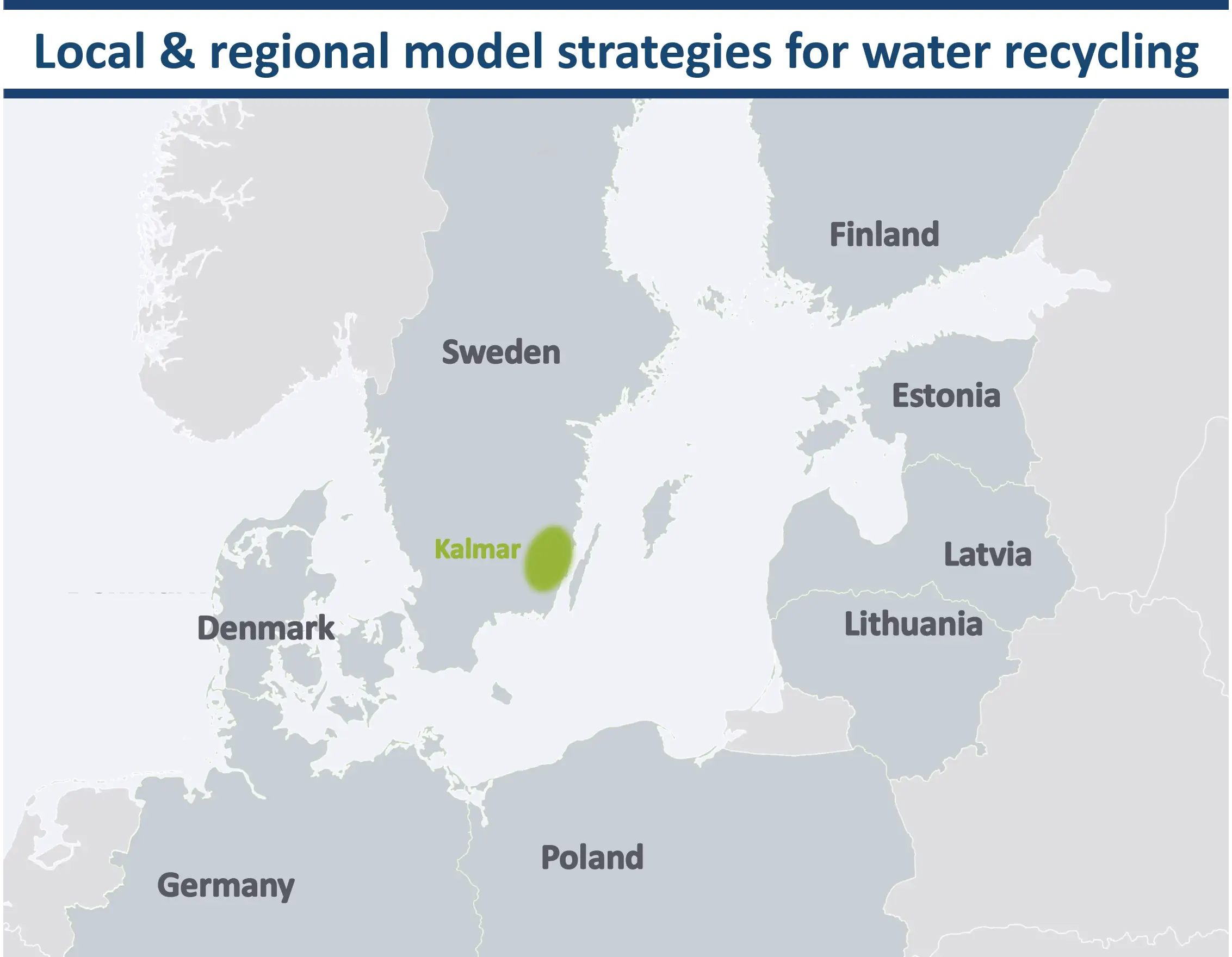
  • Territory: Kalmar Municipality, Sweden
  • Responsible institution: Kalmar Municipality
  • Scope:
  • Adoption: December 2025

Water Recycling, Fast Forward

In Kalmar, Sweden, the water future of the Baltic Sea Region is already almost a reality. After experiencing several droughts in recent years, the question here is no longer whether water recycling is needed, but how it should be done. Successful pilot measures are pointing the way ahead, while a new wastewater treatment plant already under construction is set to move things forward in big steps. It is a collective effort in which key actors are pulling together and the municipality is leading by example.

The seriousness with which Kalmar Municipality is pursuing systematic water recycling spans an area the size of three football pitches. That is the footprint of the new “Kalmarsundsverket” water recycling plant now under construction and scheduled to open in 2027. Once it comes into operation, it is intended to do far more than a conventional wastewater treatment plant. Municipal wastewater will no longer be treated only to the point where it can be discharged into surrounding waters and thereby returned to the natural water cycle. With an investment of just under €200 million, the facility is the largest single investment in Kalmar’s history. It will also be designed to produce large volumes of fit-for-purpose water in a range of quality levels – for example for irrigating green spaces or for use as process water in industry. It will even be able to produce high-quality drinking water from the wastewater of Kalmar and the surrounding area. That is why it is referred to as a water recycling plant rather than a wastewater treatment plant.

A collective effort towards water recycling

Even so, many questions still need to be answered. Who exactly will be the first customers for the different types of water, and how can this be rolled out on a larger scale? What would sensible pricing look like – pricing that creates additional incentives to use recycled wastewater? What regulatory requirements still need to be met? How will water of different quality levels in addition to drinking water reach the places where it is needed? And many others besides.

All signs suggest that Kalmar will deal successfully with these challenges as well. What has taken concrete shape in the form of Kalmarsundsverket is a collective mindset that has already set so much in motion. It is marked by a strong determination to approach the move into water recycling as a joint effort. There is a clear resolve to think all of this through in a coherent way, to lead by example as a public authority, and to do the work required: communicating the need for change, connecting key actors, coordinating their activities, steering the issue effectively through good governance, and committing the financial resources needed to make it happen.

It all began with the recurring heatwaves of recent years, which led time and again to temporary water shortages. Concrete experiences of this kind are what cause people to rethink and act. In Sweden, where problems are often approached and tackled very pragmatically, this is especially true.

A typical example of how water recycling is being approached in Kalmar is the WaterMan pilot measure developed by Klas Eriksson from the municipal administration. During several summers marked by drought, Eriksson, who works in the municipal parks department, needed to find a way to keep the city’s parks watered. As an experienced agricultural technician, he knew that in such months even stored rainwater can run short. So his attention turned to municipal wastewater, where supply would be far more reliable. He researched what technologies might make this possible and came across a solution that had already been used on Swedish farms for several years: UV water disinfection. Eriksson had the system installed in a mobile container and placed it near the old wastewater treatment plant, beside the underground pipe through which Kalmar’s treated wastewater is discharged into the sea.

Great applause for a “Klas A Solution”

Since the summer of 2024, water can be pumped out as needed at this location, treated with UV light in the container, and filled into a tank trailer. The trailer is then pulled by a tractor to thirsty trees and green spaces, which are irrigated directly via a hose system. A large sticker on the tank communicates clearly: “Irrigated with recycled water.” After staff in the parks department had overcome their initial reservations, the people of Kalmar, too, are now gradually getting used to the idea that recycled water is becoming the new normal. It poses no danger to anyone. If permanent quality monitoring were added, the UV-treated water would meet quality class A under EU Regulation 2020/741. That would even make it suitable for irrigating edible crops such as potatoes or strawberries in agriculture. Eriksson had all of this confirmed by the relevant expert assessments. “The technical hurdles were not actually that high. It was more about winning the trust of the staff. But that, too, has been achieved.” That is Eriksson’s sober conclusion. The WaterMan partners were considerably more enthusiastic than the calm and friendly Swede himself. They gave him a big round of applause for this “Klas A Solution”.

From Klas Eriksson’s mobile container, it is only a short drive to further proof of Kalmar’s determination – and of the way public authorities in Sweden see themselves not only as enablers of important forward-looking projects , but also as institutions that lead by example. From the outset, the new municipal hospital was equipped with a multi-pipe system. Alongside the drinking-water and wastewater lines, there is a third pipe network through which recycled wastewater from the new treatment plant can be distributed throughout the building – for example for flushing toilets or washing ambulances. In addition, there are closed internal loops within the building that recycle used shower water as greywater for toilet flushing. As part of the WaterMan project, a feasibility study examined in greater detail how this system could ideally be linked to the new water recycling plant.

Bringing all this together into a coherent model strategy through an iterative learning process

All of this is very much in line with the WaterMan philosophy: in future, not every application should use valuable drinking water drawn from groundwater. Instead, water recycling should provide additional fit-for-purpose water in different qualities for different uses. This also includes encouraging people at local level to take action with the means already at hand – in other words: just get started. A small wastewater recycling pilot already delivering impressive results. A large plant under construction that will do something similar on a much bigger scale. A first building already designed for exactly these kinds of uses. And many other initiatives, ideas and actors besides. The task now is to coordinate all of this well and, through an iterative learning process, shape it into a coherent model strategy. That is the task of environmental engineer Hanna Berggren from Kalmar Municipality, who works closely with the local utility Kalmar Vatten, with local politicians and with the local business community. This also includes, for example, sports clubs that want to irrigate their playing fields. Bringing football clubs together with Klas Eriksson is another important first step. Every drop counts. In the summer months, Eriksson can already provide some relief – especially when drinking water has to be rationed, as has often been the case in the Kalmar region in recent years.

People, too, need to follow the example of water

“To have the right systems tomorrow, we need the right questions, the right encounters, contacts, initiatives and conversations today,” says Berggren. For all the determination and progress that can already be seen in Kalmar, there is still a great deal of work to be done. And above all, the process will not unfold in a strictly linear or schematic way. Rather, people and planners alike need to get used to following the example of water itself: being flexible, seizing opportunities as situations and constellations change, and finding the most effective path to the goal. That is why the municipality did not stop at merely producing a strategy paper on water recycling, but also created a coordinator position.
For example, the extent to which Kalmarsundsverket will produce and supply different water quality levels from 2027 onwards will also depend on how many users can be persuaded to sign the relevant contracts. And what exactly will those contracts contain? What prices will be possible? These questions are also intertwined with legal issues. In Sweden, different pricing for water of a lower quality than drinking water is not yet possible. For the time being, local politicians in Kalmar can only gradually raise the price of drinking water in order to create incentives for businesses and households to make greater use of fit-for-purpose water later on. It is complex, it is interconnected, and above all it is a matter of communication. A perfect fit for the personable Hanna Berggren, who has a real talent for winning people over to the idea of water recycling. “My experience is that a great many people in this region are already working on the issue,” says Berggren. “But so far, they are often still working in parallel rather than together.” It now falls to her to keep bringing the key actors together around one table and to connect the different strands in a meaningful way.

Far more than a technology project: a whole new attitude to water management

Here in Kalmar, too, the motto is “Spread the Word”, although the ground is already far better prepared in communicative terms than in many other Baltic Sea regions. Even among the general public, memories of water shortages during previous summers are still very much alive. Kalmar Vatten did not really need to reinforce that message with a publicity campaign. Yet across the region, large billboards featured a camel as a friendly mascot encouraging people to use drinking water sparingly. That was in the summer of 2016, when households were at times even forbidden from using drinking water for their gardens or filling their pools.

What Kalmar is showing goes far beyond a technology project. It is also more than a strategy paper. It reflects a whole new attitude to water management in a region where the ready availability of drinking water had long been taken for granted. And it is a dialogue about how to implement concrete measures, carefully coordinated by people who know what they are doing. After repeated experiences of drought, the question here is no longer whether water recycling is needed, but how. Kalmar is also a growing municipality, where water demand will continue to rise in the coming decades as inward migration continues. One only has to set those forecasts against the climate projections to see how serious the situation is. Yet in a certain way, the advance of climate change can also be a reason for optimism. Elsewhere around the Baltic Sea, people will go through situations similar to those Kalmar has faced in recent years. And that direct experience is a crucial factor in ensuring that measures and strategies for water recycling are then pursued all the more decisively.

In-depth information on the strategy

Strategy overview (final status) These slides present the final shape of the strategy, including its context, adoption, and key lessons learned.

Download slides

Account of the elaboration process These slides present the elaboration journey of the strategy step-by-step from first discussions to the adopted version.

Download slides

Collection of further materials

Would you like to get personal advice on water recycling? Contact us!