- Home
- News
- Water Recycling Toolbox
- Use cases & solutions
- Stormwater recycling for fountain operation and greenery irrigation
- Diverse utilisation of stormwater with the aid of “multi-dams”
- Stormwater retention pond for water recycling in municipal services
- Rain garden for the greening of a public car park
- Recycling treated wastewater for irrigating green spaces
- Recycling treated wastewater for agricultural use
- Recycling treated wastewater for commercial use
- Recycling treated wastewater for hydrogen production
- Recycling treated wastewater in public buildings
- Recycling public swimming pool water for canal flushing
- Regional pathways
- Methodological guidelines and tools
- Best practices outside the Baltic Sea Region
- Policy Dialogue
- Helpdesk and further resources
- Use cases & solutions
Recycling treated wastewater for hydrogen production
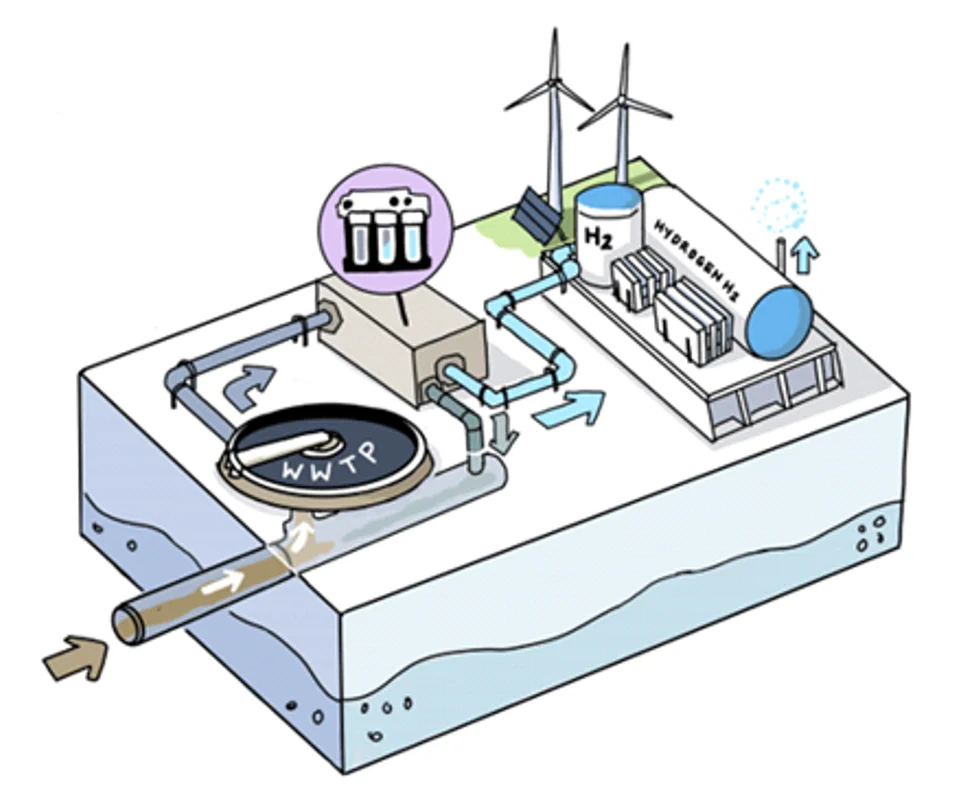
Brief intro to the WaterMan pilot measure
This feasibility study investigates whether treated municipal wastewater on the island of Bornholm can be further purified to ultra-pure water (UPW) for hydrogen production by electrolysis (PtX), and whether this can serve as a viable alternative to seawater desalination. To meet the required water quality, membrane-based technologies such as reverse osmosis (RO) are used to further purify the treated effluent.
The study proves that the island’s twelve existing wastewater treatment plants, or an envisioned centralised one, can provide the necessary water volumes for both a 25 MW electrolyser and a large-scale 800 MW PtX scenario. It also demonstrates that treated wastewater can be a significantly more cost-effective and energy-efficient option than seawater desalination: according to the life-cycle analysis, using treated wastewater can reduce energy consumption and the CO₂ footprint by up to 44 percent, provided wind power is used for purification – a synergy that exists on Bornholm. The study further confirms a central strategic insight: groundwater-based drinking water could be reserved for the population, if industry is supplied with fit-for-purpose water from alternative sources such as recycled wastewater.
- Type of pilot measure: Feasibility study
- Location: Bornholm island (Denmark)
- Water source: Treated municipal wastewater
- Type of treatment: Membrane-based technologies such as reverse osmosis (RO)
- Target water quality: Ultrapure water (UPW)
- Utilisation: Hydrogen production by electrolysis
- Return to natural cycle: WWTP recirculation, environmental discharge (diffusion systems) or Zero Liquid Discharge (resource recovery)
- Responsible: BEOF – Bornholm’s Energy & Utility Co. A/S
- Completion of the study: November 2025
Download summary here!
Further information on the pilot measure
Scope & first results of the feasibility study (current status)
(pdf, 1,8MB)
Take a look at these slides for a concise overview of the current progress and results of this feasibility study.
The evolution of the study step-by-step (until today)
(pdf, 2,4MB)
These slides document the progress of the feasibility study – including key considerations, recommendations, and decisions at each stage. Scroll through to follow the process chronologically, from the initial idea all the way to the current status.
“Using Recycled Wastewater to Become an Energy Island “ - read the full story behind the pilot measure
Bornholm has used a feasibility study to examine a question that could turn the entire Baltic Sea Region into a major player in renewable energy: Could recycled water be used to produce the hydrogen needed to store wind energy? The answer is yes – and it is significantly more cost-effective than using desalinated seawater. But the right conditions have to be in place. Read more...
In-depth information on the pilot measure
Scope & results of the feasibility study (final status) These slides summarise the scope, methodology, and key findings of the feasibility study.
Download slides
The evolution of the study step-by-step (until today) These slides give an account of the work process, incl. considerations, recommendations and decisions taken at different stages. Scroll through the slides to chronologically follow the elaboration of the feasibility study step-by-step, from the initial idea to the present status!
Download slides
Collection of further materials
- Feasibility study: Water for PtX on Bornholmdownload file
The selected folder has no items.
