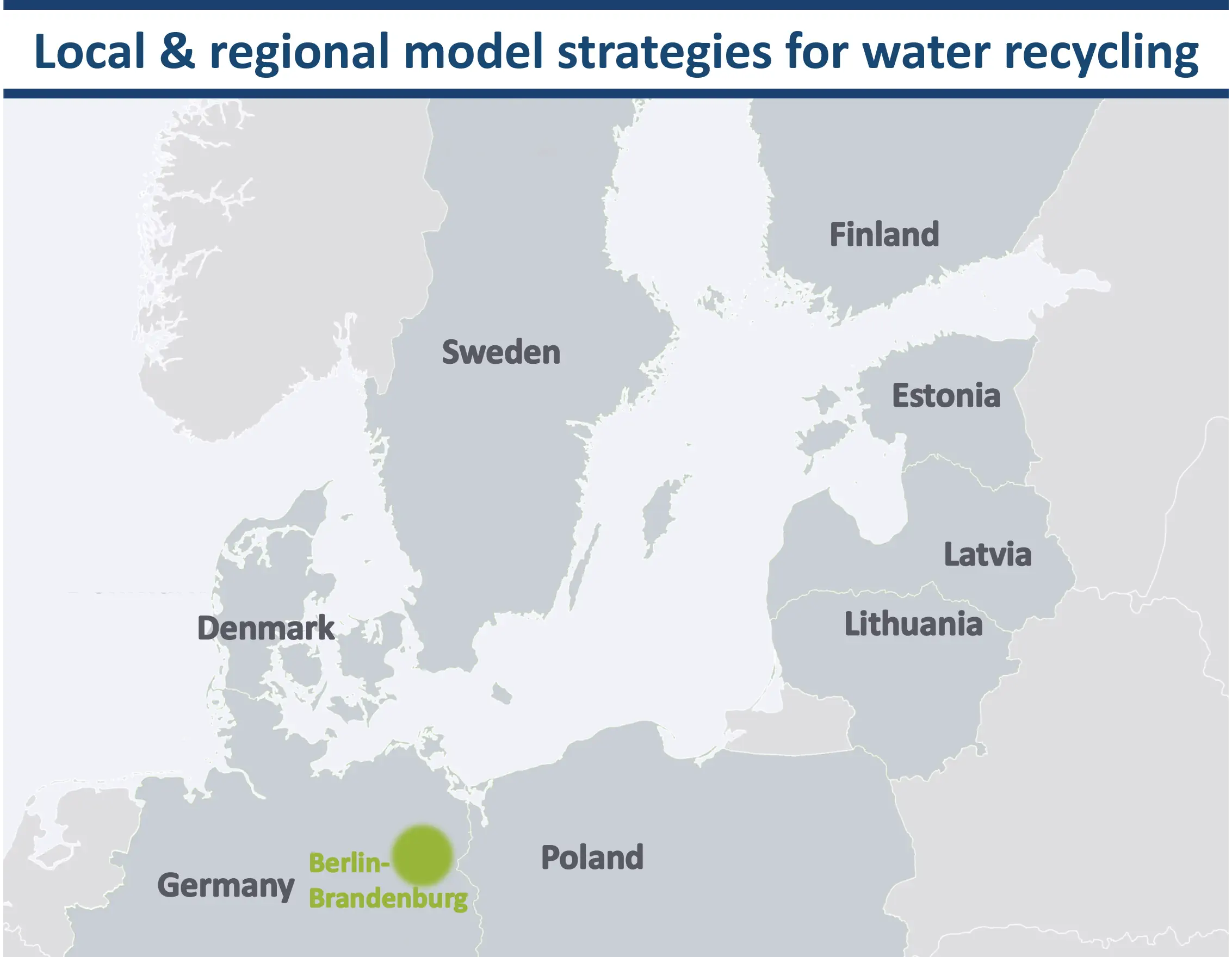
Water recycling strategy for Berlin

Brief intro to the WaterMan strategy

  • Territory: Berlin-Brandenburg, Germany
  • Responsible institution: Berlin Center of Competence for Water
  • Scope:
  • Adoption: December 2025

Spread the Facts

Berlin and Brandenburg face a shared challenge: water is becoming a scarce resource across the region. At the same time, there are many starting points for making the region more resilient in the long term. Anyone seeking to advance water recycling as part of a future-proof water economy needs robust evidence, good examples and dialogue with the relevant actors. The Kompetenzzentrum Wasser Berlin (KWB), the Berlin Centre of Competence for Water, can provide important impetus here: it brings together research, practice and regional networks, and shows how water recycling can be put into practice step by step.

Berlin and the surrounding federal state of Brandenburg are among the driest regions in Germany. At the same time, the metropolitan region has seen strong population growth since German reunification. Water availability is coming under pressure, while demand continues to rise. The Kompetenzzentrum Wasser Berlin (KWB), a research institution whose owners include Berlinwasser Holding, which is itself partly owned by Berliner Wasserbetriebe, has developed, within the WaterMan project, a strategy for how research, specialist expertise and regional networking can help advance water recycling in Berlin-Brandenburg and strengthen the region’s water resilience.

Hard facts about an increasingly dry region

The figures make the situation clear: Berlin and Brandenburg need to prepare for changing conditions in the regional water balance. Falling precipitation and rising water demand in both the city and its surrounding areas show that water will need to be used more carefully in future. Adding to the challenge is the structural transformation in Lusatia, in southern Brandenburg and Saxony. For decades, large amounts of groundwater were pumped out there to keep the lignite mines dry. “This coal extraction is due to end by 2038, and with it the constant inflow of this water into the Spree, the largest of Berlin’s rivers, will also cease,” says environmental engineer Pia Schumann, who worked on the WaterMan strategy together with her colleagues at KWB. For the metropolitan region, water demand is projected to rise from around 273 million cubic metres per year today to roughly 322 million cubic metres per year by 2050, an increase of around 18 per cent. In addition, Berlin’s Master Plan Water assumes that, with significantly lower groundwater recharge, additional demand in Berlin alone could reach up to 55 million cubic metres per year. Across the region as a whole, additional or replacement demand of around 50 to 100 million cubic metres per year is expected.

With the Berlin Master Plan Water, the German capital has already created a strategic framework for responding to these developments. It sets out which measures may be needed to secure water supply in the long term and make Berlin more resilient to dry periods and declining water availability.
Against the backdrop of rising demand and declining availability, Berlin, Brandenburg and Saxony are also jointly examining a wide range of options, from large-scale approaches such as pipelines for desalinated Baltic Sea water or water from reservoirs in the low mountain ranges to local and regional solutions. These include targeted groundwater recharge, measures to reduce water demand, blue-green infrastructure that allows rainwater to infiltrate on site, and the reuse of treated wastewater near treatment plants. Local measures in particular are seen as promising, because they are often easier to implement and require fewer actors to be involved.

This is exactly where water recycling comes in as a pragmatic building block. Drinking water should be used above all where drinking-water quality is genuinely required. Where that quality is not needed, and where local conditions allow, treated wastewater from existing plants, as well as treated rainwater and greywater, could be used in future, for example in agriculture, in industry, or to irrigate urban sports grounds and green spaces. Water recycling is already being tested in Berlin and Brandenburg by different actors and in different fields of application, including agricultural irrigation and greywater recycling. Alongside KWB, other active players include the German Environment Agency and Berliner Wasserbetriebe. One practical example is Hobrechtsfelde, where treated wastewater from the Schönerlinde treatment plant is returned to the landscape to support rewetting. KWB’s research builds on exactly this kind of local experience.

The strategy KWB developed within the WaterMan project follows the fit-for-purpose principle. The key questions are therefore these: Which water quality is needed for which use? Which potential users come into question – farms, for example, or industry? From which source can the water be supplied, and how would it need to be treated?

Or, put more simply: who needs which water, where?

Within WaterMan, KWB focuses in particular on treated wastewater. In a city like Berlin, which uses around 600,000 cubic metres of drinking water a day, treated wastewater is available very reliably and in large volumes as the output of wastewater treatment plants. “One key project in our work within WaterMan is therefore a feasibility study that we prepared around the Ruhleben treatment plant,” Schumann explains. It is one of the largest inner-city wastewater treatment plants in Germany and is located in the direct vicinity of a commercial area. Because of new legal requirements, the plant is being expanded so that nutrients and trace substances can be removed more effectively in future, improving the quality of the treated effluent. This reduces the additional technical treatment effort that would be required for possible reuse.

To start the dialogue with potential users of treated wastewater, all businesses in the surrounding area were first identified, followed by a screening and prioritisation based on expected water demand in order to identify the most relevant user groups. On this basis, more than 20 companies were approached directly. The discussions showed general interest, although no concrete use cases emerged initially. A car wash and the neighbouring power plant were identified as particularly relevant, since higher water demand can be expected there than in other businesses. These two possible applications were therefore looked at more closely.

A strong willingness to use treated wastewater

In the rural surroundings of Berlin, there is already a strong willingness to engage with water recycling – especially among Brandenburg’s water suppliers. The municipality of Stahnsdorf approached Berliner Wasserbetriebe on its own initiative, and Berliner Wasserbetriebe in turn commissioned KWB to examine the potential of the local treatment plant for water recycling in greater detail.

The KWB team did not need long to think about it. This was a valuable extension of the feasibility work being developed within WaterMan and intended to feed into KWB’s broader water recycling strategy. For Brandenburg, irrigation during the vegetation period could become the central future use case. It can be expected that water shortages will occur more frequently during exactly those periods. At the same time, treatment plants in the Berlin hinterland, as well as in Brandenburg’s larger towns, continuously provide significant volumes of treated wastewater. What matters most, however, is proximity. Water recycling makes most sense, and becomes economically attractive, where treatment plants and potential users are located close to one another. Building new pipelines is a major cost factor and can quickly call a project’s economic viability into question.

Creating shared foundations for implementation

If water recycling is to be implemented on a broad scale in Berlin and Brandenburg, it will take more than technical solutions alone. It will also require trust, clear responsibilities and coordinated procedures. At the same time, the starting conditions differ. In Berlin, Berliner Wasserbetriebe provides one large central actor. In Brandenburg, by contrast, many local water and wastewater associations, municipalities and authorities are involved. That makes coordination more demanding, but it also creates opportunities for solutions that are well tailored to local conditions. The task now is to pool experience, standardise procedures and strengthen knowledge transfer between the actors involved. An important step in this direction is the draft DWA-M 1200 guidance sheet published in July 2025. It brings together existing technical knowledge on water recycling and is intended to provide guidance on planning, operation, risk management and permitting. This is precisely where KWB can make an important contribution through application-oriented research, risk assessment and practical feasibility studies.

Overall, the legal framework for water recycling in Germany is still evolving. First, the Federal Water Act must be amended. This will then be followed by national implementation of the EU Regulation on water recycling in agriculture, 2020/741, in the form of a federal ordinance on water recycling. The EU Regulation already sets requirements for agricultural irrigation with treated water and defines different quality classes for it. From a practical point of view, it would be helpful if national implementation also included other uses, such as urban water recycling, with suitable quality requirements. The DWA-M 1200 guidance sheet already provides important technical orientation here. The revised EU Urban Wastewater Treatment Directive also points in this direction. Where appropriate, member states are to strengthen the reuse of treated wastewater from municipal treatment plants systematically, especially in areas under water stress. At the same time, higher requirements for effluent quality can help make water recycling easier and more cost-effective in future, because fewer additional treatment steps will be needed.

A task for communication and policy design

More generally, getting water recycling off the ground is also, to a significant extent, a task for communication and policy design. KWB therefore devotes a great deal of time to stakeholder dialogue and prepares workshops, guidelines, infographics and other materials to create transparency and build acceptance. “If we want to convince more people locally as well, what we need above all are practical examples that show feasibility, and a business model that makes the use of recycled water worthwhile,” says Schumann. This was also the clear message of a webinar shortly before Christmas 2025, in which she and her colleagues presented current findings on water recycling to around 30 members of the professional community.

Pilot measures, workshops and stakeholder dialogue

KWB’s approach shows how water recycling in a Central European capital region can be shaped today: in a differentiated, technically robust and practice-oriented way, and in collaboration with relevant stakeholders. KWB’s core competences include the assessment of microbial and chemical risks as well as advanced water treatment. With the feasibility studies for the Ruhleben and Stahnsdorf treatment plants, KWB has laid important groundwork as a contribution to a future-proof and resource-efficient approach to water in the region.

KWB will continue to examine critical points at several sites and derive transferable findings for the implementation of water recycling. Ongoing direct exchange with practitioners is a key part of this. In particular, KWB aims to further expand its network in Brandenburg and continue the dialogue there. Further events and workshops are already being planned jointly with regional authorities, on topics such as risk assessment and risk management. At the same time, KWB is working on several research projects and project applications on water recycling in order to address open questions and advance new use cases in Berlin-Brandenburg and beyond. One example is ValidReuse. The project aims to make validation of water treatment systems for water recycling easier in Germany. Its results are intended to ensure that operators and authorities have greater planning certainty, that approval procedures are simplified, and that the findings feed into the further development of DWA-M 1200 as well as the national implementation of EU Regulation 2020/741.

In-depth information on the strategy

Strategy overview (final status) These slides present the final shape of the strategy, including its context, adoption, and key lessons learned.

Download slides

Account of the elaboration process These slides present the elaboration journey of the strategy step-by-step from first discussions to the adopted version.

Download slides

Collection of further materials

Would you like to get personal advice on water recycling? Contact us!