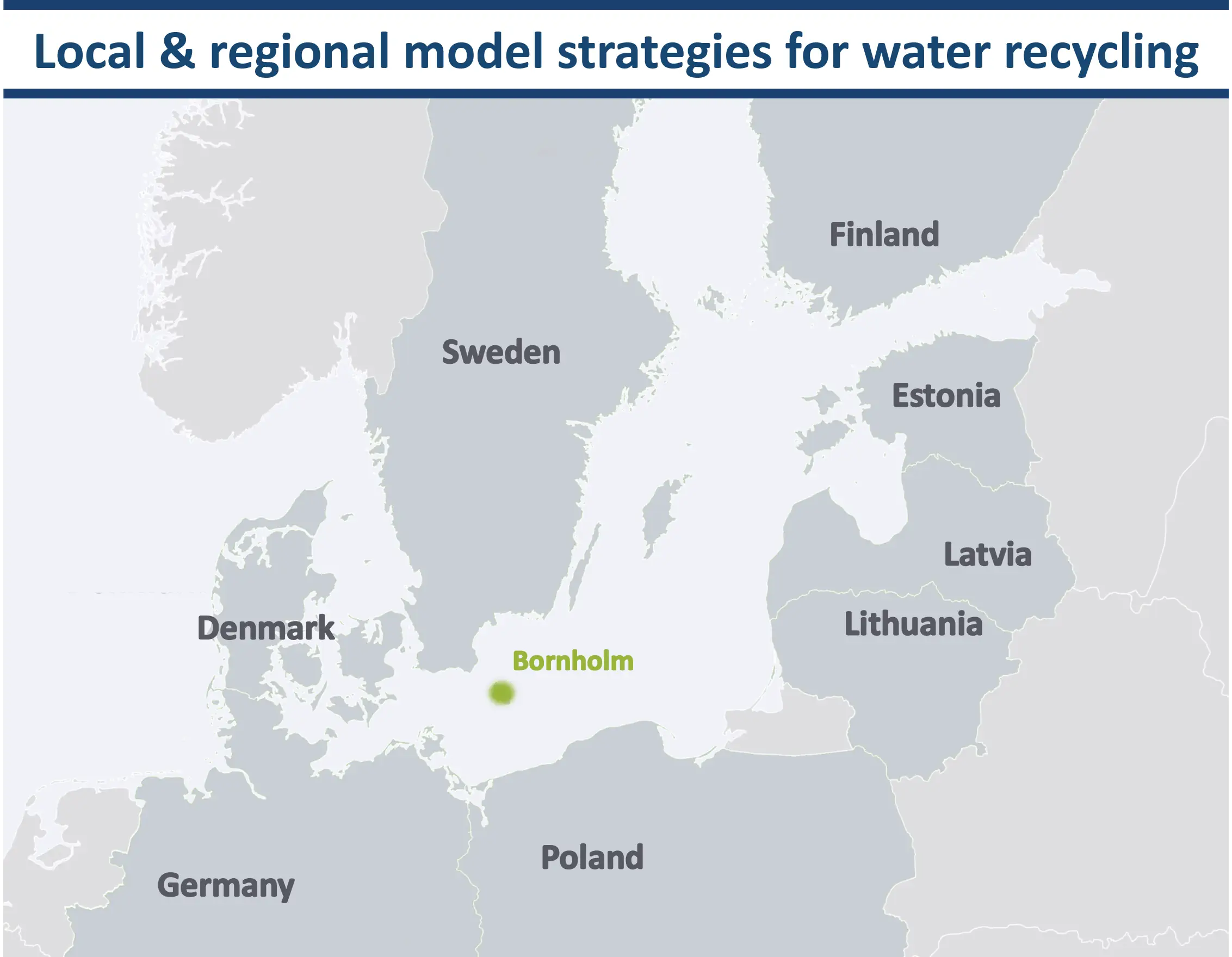
Water recycling strategy for Bornholm

Brief intro to the WaterMan strategy

  • Territory: Bornholm Island, Denmark
  • Responsible institution: Bornholm’s Energy & Utility Co. A/S
  • Scope:
  • Adoption: December 2025

One Island, Many Solutions

From low-tech to high-tech. From the revival of tried-and-tested filtration techniques to refining the outputs of municipal wastewater treatment plants into ultra-pure water (UPW) for hydrogen production. With its model strategy for water recycling, the Danish Baltic Sea island of Bornholm maps out a broad spectrum of possibilities. And it does so in a remarkably innovative way – driven by the local utility’s own research department.

When Paolo Silva takes people through the slides of the water recycling strategy, just a few keywords are enough to make clear that something much bigger is being set in motion here: energy island, hydrogen production, the construction of a new central wastewater treatment plant, a technology library. Of course, none of this is the work of Silva alone: he is part of a broader team at the local utility BEOF that has developed all this. And yet, perhaps this broad perspective also has something to do with his own background. A native of Portugal, Silva first moved to Copenhagen to study water and environmental engineering, and later settled on the Baltic Sea island of Bornholm for personal reasons. In a sense, his outsider’s perspective on the island is closely tied to his biography. Someone who comes from a very different place and puts down new roots often sees the qualities and potential of a place with particular clarity – sometimes more clearly than those who have always lived there: the island’s summer beauty, but also its dark cold in the winter months. And as an expert in water management, Silva also has a very clear view of its challenges and opportunities when it comes to water and energy.

The model strategy that he has helped shape so substantially therefore does more than outline ways of adapting to climate change and to future periods of water scarcity. It positions Bornholm as a showcase region for water recycling. Here, water recycling is not merely an environmental project, but part of a broader innovative vision for sustainable supply and energy independence.

A solid factual basis for local political decisions

One thing that sets Bornholm apart from most other WaterMan model regions is this: the main actor at the table is not primarily the municipality or a regional association, but the municipal utility itself – BEOF, Bornholms Energi & Forsyning A/S. BEOF always operates within the framework set by its stakeholders. At the same time, its owners have given it the freedom to establish a research department that can take initiative itself. Silva works in this department. Together with his colleagues, he is tasked with building an evidence base that local decision-makers can later rely on when making political and operational choices. “Our role is to move ahead and gather experience,” says Silva, “so that politicians and administrators on Bornholm do not have to make decisions in the dark but can rely on solid evidence.”

Pilot measures and feasibility studies, such as those BEOF has also contributed to the WaterMan project, play a crucial role in building this knowledge base. In this case, these include a pilot measure on treating municipal wastewater with a simple slow sand filter – a technology that was already developed in the 1970s – as well as a feasibility study on producing ultra-pure water for Power-to-X (PtX). At the same time, both strands are being developed alongside plans for a new central wastewater treatment plant, which is likewise being developed by BEOF. A closer look at these current projects shows that Bornholm’s model strategy is by no means generating purely local solutions but has considerable relevance far beyond the local context.

Unlocking a vast potential

The Power-to-X project is about unlocking a vast potential that exists on Bornholm and in its surrounding waters: wind energy. To harness it and make it usable on a large scale, it must be transported from this remote place to where it is needed. One alternative to enormous power lines is hydrogen as a storage medium. Yet producing hydrogen from wind energy through a chemical process requires large volumes of highly purified water that does not need to be of drinking-water quality – ideally obtained through regional water recycling, since seawater desalination is complex. “The hydrogen production scenario we explored here is not just a lighthouse project,” says Silva. “It is also the best proof that recycling municipal wastewater is not only ecologically sound, but also economically relevant.” Reuse would help to meet water demand while at the same time reducing pressure on groundwater and protecting sensitive coastal ecosystems.

In this context, the new large wastewater treatment plant would play a central role as the source of the feedwater. At the same time, it would become an important hub for providing recycled water in different quality levels for a wide range of applications – from agriculture and commercial processes to treatment for PtX.

A functioning pilot on politically shaky ground

Even though technical feasibility has already been demonstrated in many cases, the regulatory framework has been – and remains – in flux. This was particularly apparent in the pilot measure in Svaneke, which centred on a slow sand filter designed to recycle municipal wastewater for agricultural irrigation. The technology was deliberately chosen as a simple solution: low-cost and low-maintenance, yet effective. The recycled water reaches EU quality class D, which means it can safely be used to irrigate seeds for edible crops. However, although EU Regulation 2020/741 clearly defines such minimum requirements for the reuse of treated wastewater in agriculture, the Danish Ministry of Agriculture initially decided on a national opt-out and suspended implementation of the regulation. This was because the ministry had concluded that Denmark would not face water scarcity in agriculture in the future. The fact that many farmers saw this quite differently on the basis of their own local experience, and had already expressed interest in the recycled water, carried no weight in Copenhagen’s decision. So although technically sound and straightforward to implement, the slow sand filter initially found itself on politically shaky ground. “That was a moment of uncertainty,” Silva recalls. “We had a functioning pilot measure, but no clear support at national level.”

The situation was different for the hydrogen feasibility study, where the potential reuse of water was linked to industrial processes. The national agricultural opt-out had no immediate effect on this application. On the contrary: the country’s hydrogen strategy could in future provide additional momentum for the development of water-based circular economy systems in other sectors as well. Then, with the revised EU Urban Wastewater Treatment Directive (2024/3019), water recycling finally received the new tailwind it needed – and across sectors. The directive sets out a clear ambition for municipal wastewater treatment plants to focus much more strongly on reuse in future, in order to conserve resources and make water supply more resilient.

Now the future can be shaped with even greater confidence

For Bornholm, this was an important signal: the strategy is aligned with the regulatory future we are moving towards – and that future can now be shaped with even greater confidence. In the slow sand filter measure, however, the team was not about to let the political uncertainties throw it off course. Since use in crop production was not yet possible, they initially demonstrated the value of this water in an adjoining test greenhouse. The project thus serves several functions at once: it confirms feasibility on a small scale, builds acceptance among key stakeholders, and provides data for later scaling up. As Silva puts it: “The slow sand filter in Svaneke is our laboratory at a 1:1 scale – here we can show people that water recycling is already working in a very safe and reliable way.”

It is regrettable that construction of the new wastewater treatment plant – with its large volumes of high-quality water and its central distribution function – was first accelerated by local politics in 2025, only then to be returned to its original, slower timetable. But this is not a fundamental setback. The overall direction of development is clear. Through its research department, BEOF is in a position to integrate existing and planned structures in a meaningful way and act as a driver of these integrated concepts.
Just as the broader framework still needs to settle, there are also questions to be clarified and problems to be solved in the pilots themselves and their practical roll-out on a larger scale. In the case of agricultural irrigation, for example, logistical challenges remain. How does the water get from the treatment plant to the field? Two options are currently under discussion: mobile water transport by tanker truck and pipe-in-pipe solutions along existing infrastructure. Both options need to be analysed and assessed more closely, including in terms of cost and seasonal usage scenarios. In addition, decentralised storage such as mini-wetlands on farms is being discussed as a possible buffer.

Firmly anchored in local governance, professional expertise and public engagement

Despite all these challenges, Bornholm benefits from a strong institutional foundation. With BEOF as both utility and think tank, and the municipality as its main owner, the whole approach is firmly anchored in local governance, professional expertise and public engagement. The model strategy was developed in exchange with partners from administration, agriculture and academia, and was accompanied by workshops, on-site visits and participation in national and transnational consultations. At the same time, BEOF continues to expand its structured knowledge base – from a technology library and a water quality database to monitoring tools that will also feed into the WaterMan Toolbox and can also be used beyond Bornholm. “What we are developing here on Bornholm should always be transferable to other parts of the Baltic Sea Region as well. We see our island as a testing ground, but the relevance of our findings should extend far beyond our own coastline,” says Silva, whose own path to Bornholm perhaps makes it natural for him to think beyond local conditions.

If the Baltic Sea Region is to become more water-resilient quickly, that will work best if everyone thinks this way and shares their results consistently. Bornholm’s model strategy is an impressive example of exactly that. It shows that immense economic and ecological opportunities can grow out of such an approach – and that a utility company can take the lead in this process. It is an inspiration to others to set out on the same path.

In-depth information on the strategy

Strategy overview (final status) These slides present the final shape of the strategy, including its context, adoption, and key lessons learned.

Download slides

Account of the elaboration process These slides present the elaboration journey of the strategy step-by-step from first discussions to the adopted version.

Download slides

Collection of further materials

Would you like to get personal advice on water recycling? Contact us!

Paulo Martins Silva +45 40 243 932
Get to know our other Helpdesk agents