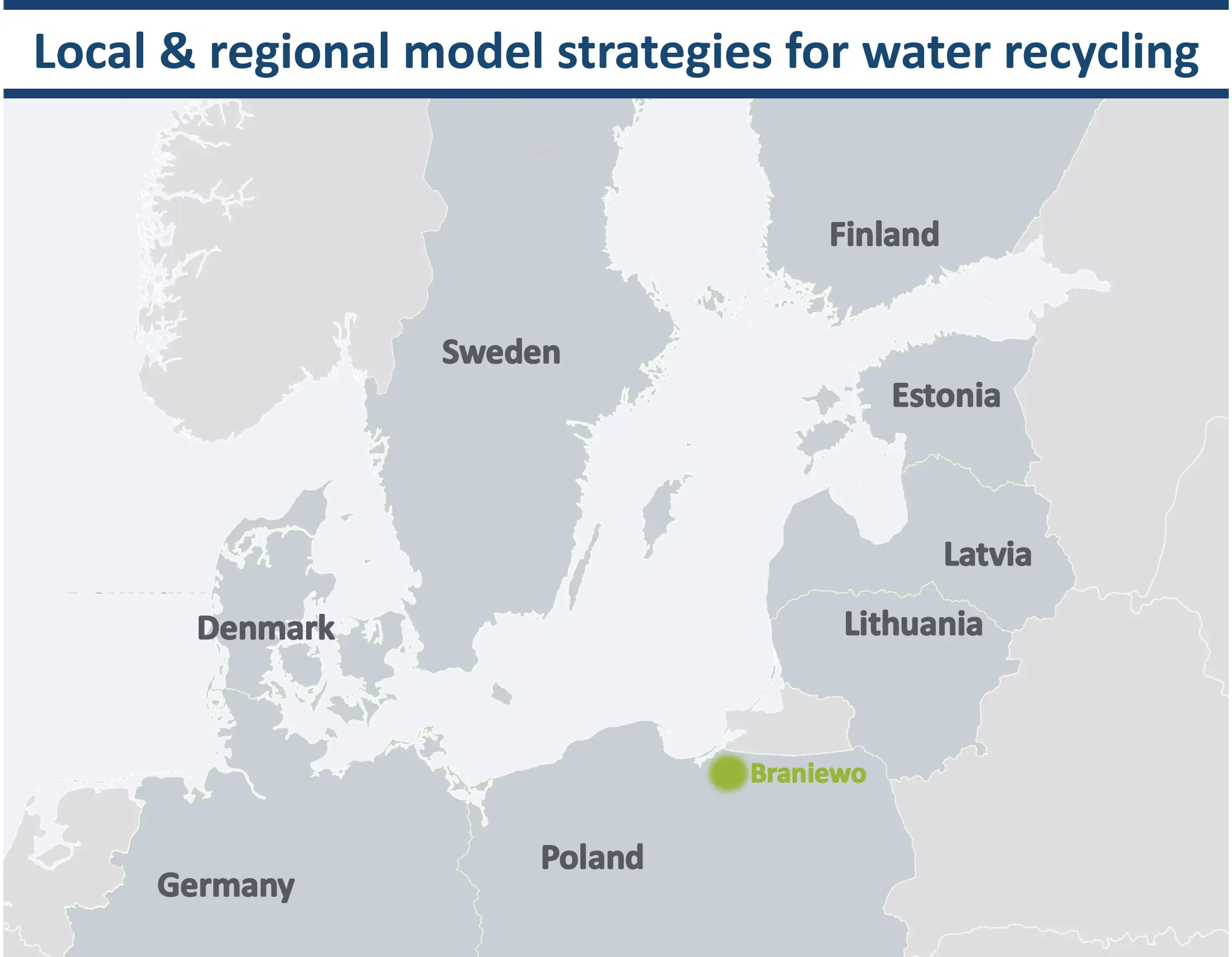
Scope: Action plan for sustainable rainwater management and water recycling for Braniewo Municipality in Poland
Adoption: December 2025
The Power of Local Action
Braniewo in Poland shows the potential of small towns to take the lead in water recycling. Where distances are short, there is often greater room for flexibility. Committed local stakeholders can get started more easily and receive hands-on support from the administration – not least when it comes to making use of policy windows at national level. All of this is brought together here in a classic local strategy paper with a clear objective that provides orientation.
How far Braniewo has come is evident from the fact that its model strategy for water recycling has already taken shape in the form of a published document. It exists in printed and bound form. More than that: the 70-page document, developed and finalised with the participation of local stakeholders in public workshops, has already been adopted by the town council. It is already feeding into concrete policy processes. The fact that the strategy is so convincing and already having an impact is also due to the concrete evidence it can draw on from two pilot measures. These were developed in cooperation between the municipality of Braniewo and the Department of Environmental Engineering at Gdańsk University of Technology under the leadership of Magdalena Gajewska. Braniewo’s model strategy grew out of these pilot measures and the process surrounding their development – which, incidentally, is very typical of the WaterMan philosophy: just get started. It is often only through concrete measures that it becomes truly clear how the overarching strategy needs to be designed, oriented and sharpened. So here, too, it makes sense to begin with a brief look at these activities.
Education is crucial to establish the issue in urban society
One example is the new rain garden on the car park of the public swimming pool. What looks like a simple planted area with shallow depressions is, in fact, a smart retention system that captures rainwater from the adjacent asphalt surface, stores it temporarily, releases it in a controlled way, and thus contributes to groundwater recharge. And that is not all: a rain garden like this also helps to prevent flood events on the Pasłęka River and to cool the microclimate on hot, dry summer days. Braniewo has indeed seen more and more of those intensely hot days in recent years, and they have already led to short periods of water scarcity – something that is also explained on information boards next to the installation. The installation has been consciously designed as a learning site. Water and climate education are essential if water recycling is to become firmly established in urban society.
Only a few metres away, in the technical room of the swimming pool, the other pilot is located. There, alongside the filtration system, a new installation has been added that recycles the backwash water for municipal purposes. The idea is to use it as fit-for-purpose water for cleaning the sewer network and, in the future, perhaps also for irrigating the neighbouring sports field. This pilot is a genuine pioneering achievement. Recycling swimming-pool water has never before been systematically tested. Even after intensive research, no examples or models could be found anywhere in the world to build on. So Braniewo moved ahead and, in the interest of transferability, carefully documented all operational data and made it transparent. The team is already thinking beyond the pilot, identifying scaling options and highlighting which operational processes should be taken into account in the planning stage of future public buildings. Where reservations remain about irrigation with recycled water – for example on the part of the grass supplier to the local football club – Braniewo is relying on dialogue and on the growing body of evidence emerging from day-to-day operation.
Linking technical solutions and communication tasks through holistic governance
The school classes that arrive here every day by bus for swimming lessons and learn about the two water recycling pilots from the information boards are already easier to win over today. After all, the benefits of the pilots are easy to grasp. Jerzy Butkiewicz, who is responsible for water issues in the municipal administration and coordinates the pilot measures within the model strategy, emphasises the importance of the educational aspect: “Children can become ambassadors for water recycling at home and can also convince their parents.” Butkiewicz, who has already coordinated the work on the pilots on site in his characteristically engaged and hands-on way between the university team and the technicians, is also responsible on the municipal side for bringing the different activities together in an overarching water recycling strategy for Braniewo. It links communication tasks with technical solutions through holistic municipal coordination and governance.
The starting point for all of this was an analysis of local risks: ageing sewer sections, more frequent heavy rainfall with a risk of flooding on the Pasłęka River, but also increasingly frequent dry spells in which water becomes scarce. Braniewo is responding through its first two pilots with targeted measures that range from low-tech solutions to more complex challenges and pioneering achievements. These are complemented by incentives for private water retention and educational activities that make water tangible as a resource. The approach is one of small but effective measures that can be scaled up step by step – guided by clear priorities and measurable results.
Being ready with a model strategy when funding windows open
A decisive advantage here lies in the strategy’s firm institutional anchoring. The findings from the pilots and workshops are feeding, among other things, into the municipal climate adaptation plan, which larger municipalities in Poland will soon be required by the national government to prepare. In this way, they are also becoming part of the City of Braniewo Development Strategy 2021–2030, creating a binding foundation for future construction and infrastructure projects. More generally, it is a considerable strategic advantage that Braniewo’s water strategy is already in place before the national climate planning procedure begins. This will work in favour of local implementation: when the funding windows associated with the climate plan open, the municipality will be able to position key measures early and secure financing more easily. Eligibility for funding at national and European level remains, after all, a decisive factor: it usually gives administrations planning certainty and additional room for manoeuvre, and helps political decision-makers move towards concrete decisions.
“The strategy helps us bring many individual solutions under one roof – from the rain garden to the climate plan,” says Butkiewicz. “That makes it easier to show the council, the administration and funding bodies how everything fits together.”
The fact that the local water recycling strategy exists as a printed and bound publication is, on the one hand, a sign of its strength. On the other hand, municipalities are also places where even the best plans can all too easily end up in a drawer. Once again, it is up to Butkiewicz, as the person responsible for water issues in the municipality, to make sure that does not happen. Instead, the strategy now has to be implemented step by step. The climate plan required by the government will help with that, but above all so will Butkiewicz’s determination: “I want to find a way to get through to the city council, and money plays an important role in that. At the same time, it is crucial to work with the public. As soon as citizens begin to engage and the issue gains more visibility, the city council will respond as well.”
How paper turns more and more into water recycling in practice
That is why Braniewo continues to rely on transparent communication and public workshops: it involves local stakeholders early on, builds acceptance, and provides the visible anchor projects that root the strategy in everyday life. In this way, a shared learning process is taking shape across the town – and paper is increasingly turning into water recycling in practice. In this combination of real pilot installations, political anchoring and broad communication, Braniewo’s model strategy is a blueprint for the whole Baltic Sea Region.
In-depth information on the strategy
Strategy overview (final status)These slides present the final shape of the strategy, including its context, adoption, and key lessons learned.
Account of the elaboration processThese slides present the elaboration journey of the strategy step-by-step from first discussions to the adopted version.