- Home
- News
- Water Recycling Toolbox
- Use cases & solutions
- Stormwater recycling for fountain operation and greenery irrigation
- Diverse utilisation of stormwater with the aid of “multi-dams”
- Stormwater retention pond for water recycling in municipal services
- Rain garden for the greening of a public car park
- Recycling treated wastewater for irrigating green spaces
- Recycling treated wastewater for agricultural use
- Recycling treated wastewater for commercial use
- Recycling treated wastewater for hydrogen production
- Recycling treated wastewater in public buildings
- Recycling public swimming pool water for canal flushing
- Regional pathways
- Methodological guidelines and tools
- Best practices outside the Baltic Sea Region
- Policy Dialogue
- Helpdesk and further resources
- Use cases & solutions
Recycling treated wastewater in public buildings
Brief intro to the WaterMan pilot measure
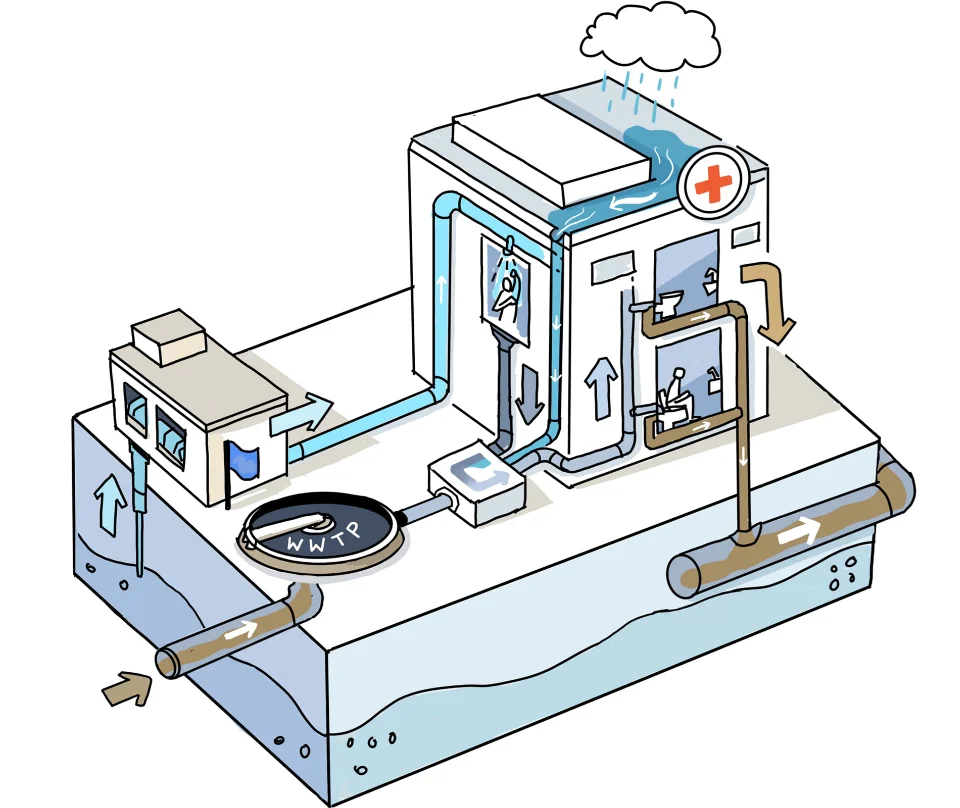
This feasibility study investigates how recycled wastewater can be used in public buildings. The point of reference is a hospital owned by Region Kalmar County, where a dual piping system separating drinking water and water for non-drinking purposes has already been installed.
The study examines whether this water could be supplied by the new water recycling plant “Kalmarsundsverket” in future, which is currently under construction in Kalmar. Other options under consideration include the use of greywater (i.e. moderately contaminated wastewater from the building itself, e.g. shower water) and stormwater. In addition to technical aspects, the study also assesses legal aspects and the economic viability of such a system. Regulatory challenges remain: for instance, in Sweden, it is currently not possible to introduce differentiated pricing for water of different qualities – making it harder to create financial incentives for using recycled water.
- Type of pilot measure: Feasibility study
- Location: Kalmar (Sweden)
- Water source: Treated wastewater from new recycling plant, greywater from public buildings, rainwater
- Type of treatment: If possible, to be avoided
- Target water quality: Fit-for-purpose water of varying quality
- Utilisation: E.g. toilet flushing
- Return to natural cycle: Discharge into sewage system
- Responsible: Region Kalmar County
- Completion: November 2025
Download summary here!
Further information on the pilot measure
Scope & first results of the feasibility study (current status)
(pdf, 2.0MB)
Take a look at these slides for a concise overview of the current progress and results of this feasibility study.
In-depth information on the pilot measure
Scope & results of the feasibility study (final status) These slides summarise the scope, methodology, and key findings of the feasibility study.
Download slides
Collection of further materials
The selected folder has no items.
Would you like to get personal advice on the use case? Contact us!
Tobias Facchini
tobias.facchini@regionkalmar.se
+46 10 358 83 83
Get to know our
other Helpdesk agents
